Long service life without loss of quality is one of the defining properties of building products. After all, replacing building materials in an already built building is a long and costly matter. When you buy products with polyurethane foam, the most modern insulation, you can be sure: the thermal insulation will last a long time!
The European Association of rigid polyurethane foam producers PU EUROPE prepared a review assessing the properties of PUR, having studied samples of the material that had served for several decades. We offer you a brief summary of the study results.
The Association turned to the FIW Forschungsinstitut für Wärmeschutz e.V. research institute in Munich to assess the quality of building materials made of polyurethane that were several decades old.
All the building materials were taken from buildings in use and were tested for:
- Thermal conductivity
- Compressive strength
- Moisture content
- Changes in dimensions and structural integrity
The tests showed that after decades of use, polyurethane insulation boards fully retained their functionality and all of their originally declared parameters and indicators. Not a trace of damage or defects was found.
Test 1: polyurethane insulation sample, 28 years of service
Test sample:
Sample 1 was taken in April 2010. The 600 x 600 mm sample, 100 mm thick, was part of a polyurethane board in an insulation layer laid in 1982 over the rafters of the gable roof of a small private house, see Figures 1 and 2.
The building experts noted in their report that the polyurethane insulation boards were fitted tightly to one another without gaps, see Figures 1 and 3.
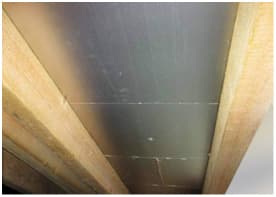
Figure 1: Inside of the gable roof: rafters and insulation layer
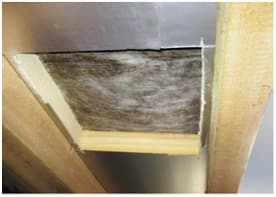
Figure 2: Taking a sample for testing
The FIW research institute assessed the following characteristics:
- Type and condition of the facing
- Uniformity, holes, voids, bubbles in the foam
- Thickness in accordance with DIN EN 823
- Moisture after drying at 70°C
- Thermal conductivity in the finished state in accordance with DIN EN 826
- Compressive strength in accordance with DIN EN 826
Fire resistance (exposure to a small burner) according to DIN 4102-1-B2
Test results
| Properties | Originally declared parameters | Parameters found after 28 years of service |
|---|---|---|
| Facing: multilayer aluminum facing on both sides, one side perforated | ||
| Thickness | 100 mm | 101.8 mm |
| Moisture content | Not detected | 0.05 vol.% |
| Compressive strength | 150 kPa | 208 kPa |
| Thermal conductivity | 0.030 W / (m.K) | 0.0292 W / (m.K) (10 °C mean temperature) |
| Fire resistance | Class B2 (normally flammable) in accordance with DIN 4102-1 No burning drops/particles | Class B2 (normally flammable) in accordance with DIN 4102-1 No burning drops/particles |
The tests showed that no damage, holes, bubbles, voids or other non-uniformity were found on the samples. One side of the facing showed traces of slight dust and moisture. The research institute specialists confirmed that after 28 years of service this polyurethane insulation board is still fully fit for use and still meets all of its declared parameters and indicators.
Test 2: polyurethane insulation sample, 33 years of service
Test sample:
Sample No. 2 was taken in September 2011 from the flat roof of a school that had been closed for repairs.
The insulation layer had been installed under the membrane. Since the bituminous layer was still in very good condition, it was possible to take a sample not of the whole insulation board but only of a small part of it, see Figures 4 and 5.
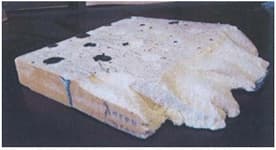
Figure 4: polyurethane sample taken from the flat roof
The FIW research institute assessed the following characteristics:
- Uniformity, holes, voids, bubbles in the foam
- Thickness in accordance with DIN EN 823
- Moisture after drying at 70 °C
- Density
- Thermal conductivity in the finished state in accordance with DIN EN 12667
Compressive strength in accordance with DIN EN 826 (at 10% deformation)
Test results
| Properties | Originally declared characteristics | Parameters found after 33 years of service |
|---|---|---|
| Thickness | 60 mm | 59.05 mm |
| Moisture content | Not detected | 0.07 vol.% |
| Overall density | Not detected | 208 kPa |
| Compressive strength | 150 kPa | 226 kPa |
| Thermal conductivity | 0.030 W / (m.K) | 0.0272 W / (m.K) (10°C mean temperature) |
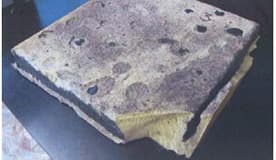
Figure 5: polyurethane sample taken from the flat roof
The research institute specialists confirmed that the polyurethane foam “has no significant damage” and is “still free of defects”. Moreover, “PUR insulation boards after 33 years of service are fully functional and still achieve all of their declared parameters and indicators”.
As a result of studying the samples, practical evidence was obtained of the long-term effectiveness of polyurethane foam thermal insulation.
What is durability?
The durability of building materials is the ability to retain the required performance indicators over a specified or long period of time under foreseeable circumstances.
Durability depends on the intended purpose of the product and the operating conditions.
Durability is an important characteristic when planning for developers, specifiers and owners when calculating the long-term operation of buildings in terms of costs and environmental impact.
In Europe, EN standards apply to polyurethane foam thermal insulation building materials. If a building material does not meet such standards, its use will be restricted. The design service life of insulation products is from 30 to 80 years.
Does durability affect life cycle cost?
The durability of insulation products largely affects the life cycle cost of a building. About 70% of such costs fall on the operation stage of the building, with the lion’s share going to heating and air conditioning. If the thermal insulation material loses its performance characteristics over time and heat transfer through the building’s outer shell increases, electricity costs can rise significantly.
Repairing or replacing insulation products before the end of the design service life will entail additional costs, since access to the insulation layer is often difficult.
Does durability affect the environmental safety of building materials?
Environmental safety indicators of products are divided into categories of impact during production, operation, and at the end of the service life. The operation stage of a building accounts for about 80% of the total environmental impact. Thus, the period during which thermal insulation retains its declared performance indicators directly affects the overall environmental safety of the building.
If the service life of a building is estimated at 50 years but the insulation needs to be replaced after 30, the environmental impact over the insulation’s service life doubles for that building. But if the insulation is not replaced, the building’s energy consumption will rise and the comfort level will fall, which will worsen the building’s environmental performance.